About the Artist
Olukokun
Poroye
Design/Technical Architect · Project Manager · Artist · Director
Olukokun Poroye Oluwaseyi Oluwagbenga Adetokunbo Olanrewaju Awolesi — also known as Sage-Causality (Poet) — is a Design/Technical Architect and Project Manager. He consults for Marriott International as Stylist Art Director for their Renaissance, Marriott, Sheraton & Autograph brands in EMEA.
His work as a visionary has led him to roles as Creator and Curator for Afro Pop Live, The Horniman Museum and AreWeUs. He is a photographer, a muser and a writer.
For two decades he has been crafting and exploring a simple proof/thought/social experiment, based on the similarities that exist in our perceived differences. Working primarily with Thaumatococcus Daniellii (Banana Leaf) in various stages of natural decay, stitched together with Raffia reed on Vertisol, he seeks to explore migration narratives — his own, and that of others — using sustainable materials and Yoruba philosophy to bring about understanding in a world set up to confuse and divide.
Olukokun Poroye* is a moniker that combines his mother's maiden name and his paternal grandmother's first name. By using this name as an artist, he pays homage to his lineage and the women that helped to create him.
Philosophy
The Similarities
in Our Perceived
Differences
At the heart of Olukokun Poroye's artistic practice lies a singular, profound premise: that beneath all our perceived differences — cultural, geographical, historical — we share fundamental similarities that define the human experience. This overarching philosophy ties together all current and future artistic essays.
This philosophy manifests through a series of artistic essays, each exploring different facets of universal human experience through the lens of Yoruba culture and sustainable materials. The first essay, "Ọ̀rọ̀ Ẹni (Conversations with Self)," examines five pillars of existence: Time (Àkókò), History (Ìtàn), Intimacy (Ìbálòpọ̀), Dreams (Àlá), and Food (Ónje).
The choice of materials is itself a philosophical statement. Thaumatococcus Daniellii — a leaf that grows, serves, decays, and returns to the earth — embodies the very cycle of life that connects all living beings. By working with materials in various stages of their natural lifecycle, Poroye creates art that is not merely about sustainability but is fundamentally of the earth.
Philosophy of Material
Why Leaves?
Plants produce the oxygen that sustains every human life on this planet. Approximately 80% of the Earth's land surface is covered by plant life — a vast, breathing organism that connects every living being through the simple, invisible act of respiration. This is not metaphor. It is biology. Every breath you take exists because a plant, somewhere, made it possible.
There is another connection, written into our very bodies. The palmar flexion creases of the human hand — the lines that cross every palm — mirror the venation patterns found in every leaf. The branching architecture that carries water and nutrients through a leaf is the same architecture that marks the surface of your hand. We carry the leaf within us.
This is why leaves are the chosen material. Not because they are beautiful — though they are — but because they are universal. Every human being, regardless of where they were born, what language they speak, or what they believe, knows what a leaf looks like. The leaf is the one material that belongs to all of us equally. It is the most democratic medium on Earth.
By choosing to work with Thaumatococcus Daniellii and other organic leaves, the art does not merely depict human connection — it is made from it.
Why a Mat?
Each canvas measures 1500 × 2000mm — the dimensions of a double mattress. This is deliberate. The scale demands a physical encounter: the viewer stands before the work as they would stand before another person, life-sized and unavoidable.
The canvas itself is a woven reed mat. Every race, every culture, every civilisation on Earth has mats. The mat is the first bed that humans adopted — the step that came after spreading leaves on the ground to sleep. From the tatami of Japan to the ẹní of Yorubaland, from the woven palm mats of the Pacific Islands to the reed mats of the Nile Valley — the mat is another universal truth. It is where we rest, where we dream, where we are most vulnerable and most human.
By using the mat as a canvas, the work rests on the same surface where humanity has always rested. The leaf became the first bed. The mat became the second. And now, both carry the art.
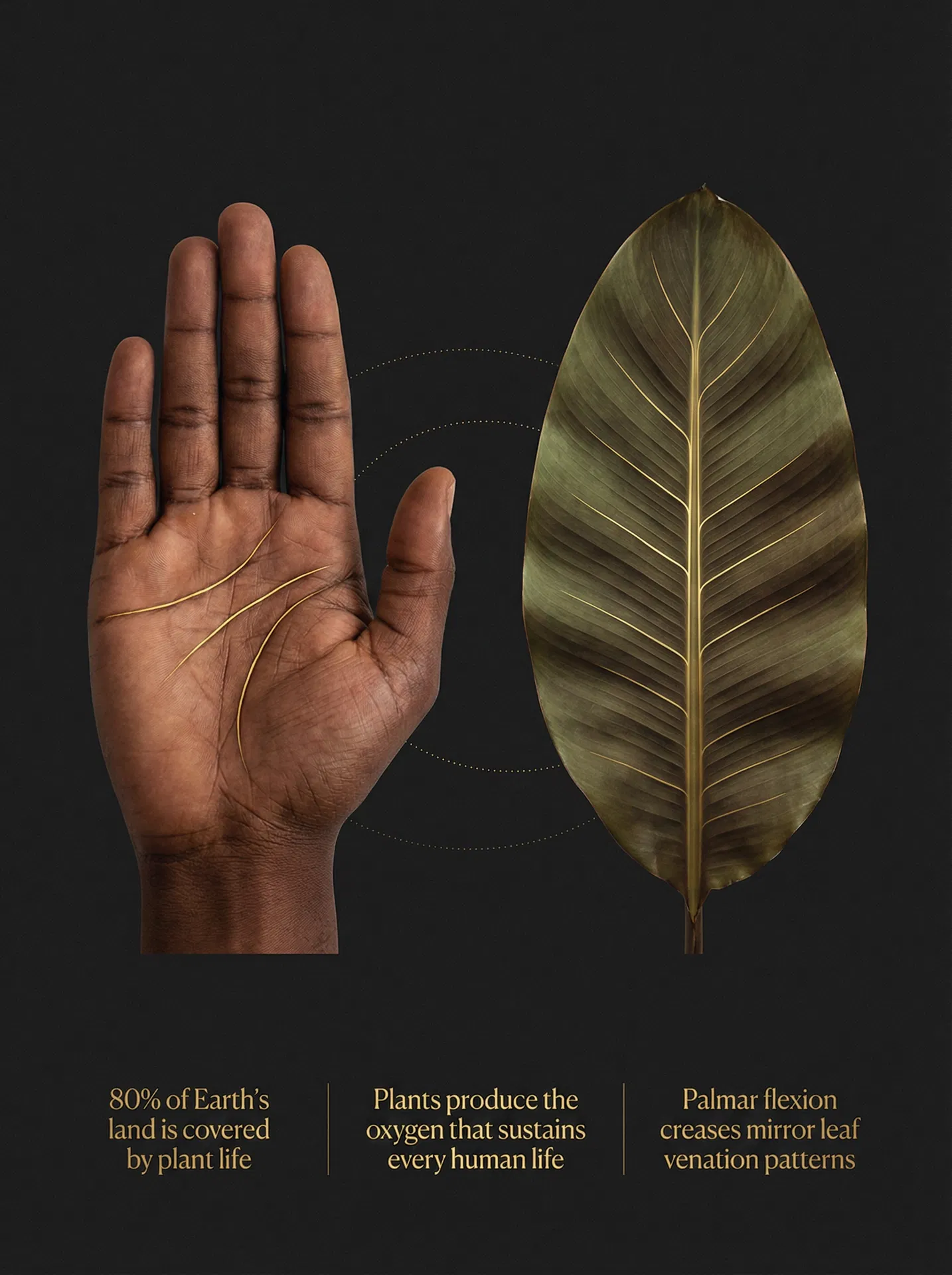
Palmar flexion creases mirror leaf venation — we carry the leaf within us
Philosophy of Form
Why Are the
Figures Made
of Leaves?
Every human figure in these works is rendered in the texture of leaves. This is not a stylistic choice — it is a philosophical one. We share a unified humanity because of our absolute dependence on ecology to survive. The air we breathe, the food we eat, the water we drink — all of it passes through the living systems of the natural world before it reaches us. We are not separate from nature. We are sustained by it, shaped by it, and ultimately returned to it.
The impermanence of life is a by-product of sustainability. Nothing in nature is permanent — and that impermanence is precisely what allows the cycle of life to continue. The best representation of this truth is the leaf. A leaf is born green, full of chlorophyll and the energy of youth. It grows and matures into yellow, carrying the warmth of experience and the fullness of purpose. It ages into brown, returning its nutrients to the soil from which it came. And from that soil, new life emerges. The cycle completes.
The human characters in these works move through these same stages. Their bodies are depicted in varying states of change — green for birth and new life, yellow for growth and maturity, brown for ageing and the return to the earth. This is not decay — it is transformation. It is the same transformation that every human being undergoes, regardless of race, culture, or geography. We are all leaves on the same tree.
By rendering the human form in leaf texture, the work collapses the perceived boundary between humanity and the natural world. It reminds us that we are not observers of ecology — we are participants in it. Our skin, like the surface of a leaf, carries the marks of time. Our bodies, like the body of a leaf, are temporary vessels for the energy of life. And when we return to the earth, we nourish the same soil that will sustain those who come after us. This is the deepest similarity in our perceived differences: we are all part of the same cycle, and the leaf is its most honest witness.
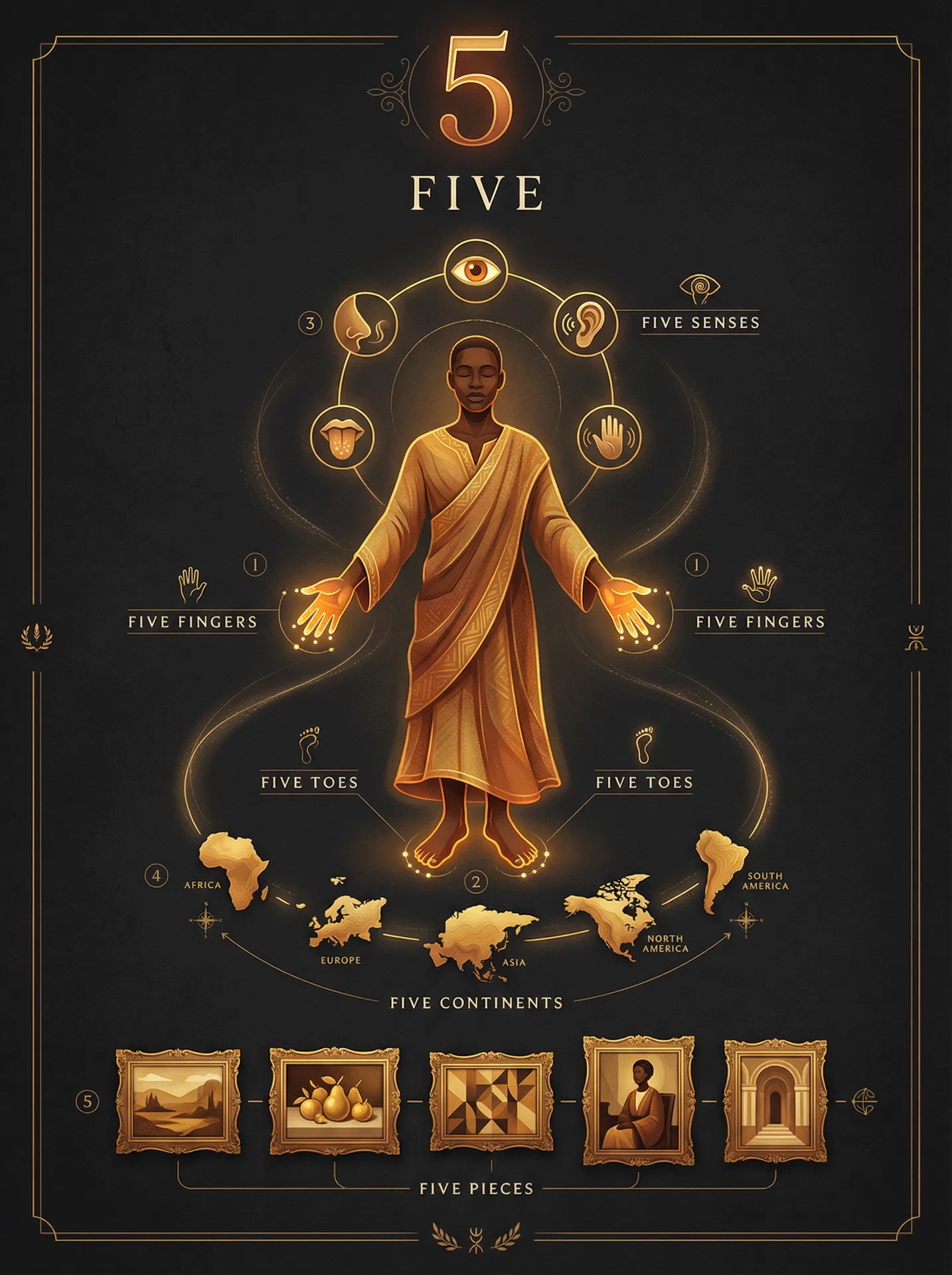
The number five — a universal constant written into every human body
Philosophy of Number
Why Five?
Every collection in this practice contains exactly five pieces. This is not arbitrary — it is a reference and homage to all human beings and their shared association with the number five. Five is the number that is written into every human body, regardless of race, culture, or geography.
We are born with five fingers on each hand and five toes on each foot. We experience the world through five senses — sight, hearing, touch, taste, and smell. We inhabit five continents across the globe. The number five is a universal constant, a biological truth that connects every human being who has ever lived.
By producing exactly five pieces for each subject matter, the work honours this shared human architecture. Each piece becomes a finger on the same hand, a sense through which we perceive the same world, a continent on which we share the same earth. The number five is not a limitation — it is a declaration of unity.
Sustainable Practice
Materials
The primary materials used in this practice — Thaumatococcus Daniellii leaves, Vertisol (earth/soil), and raffia reed — have been used in African architecture for centuries. From thatched roofing and woven wall panels to earthen foundations and decorative screens, these materials have sheltered, sustained, and defined the built environment across the continent. By bringing them into the gallery, the work honours a lineage of making that predates the Western distinction between art and architecture.
Primary Medium
Thaumatococcus Daniellii
Ẹwẹ́ Ẹ̀rán
The banana leaf — selected in various stages of natural decay, from vibrant green to deep brown. Each leaf carries its own history, its own journey through time. Traditionally used across West Africa to wrap food, the leaf is both sustenance and symbol.
Binding Element
Raffia Reed
Ọ̀pá
Used to stitch the leaves together, the Raffia reed serves as both structural and symbolic element — connecting disparate pieces into a unified whole, much like the human experiences that bind us across cultures and continents.
Landscape Foundation
Gari
Garí
A staple food across West Africa, Gari forms the textured landscapes upon which figures and narratives are placed. As a material born from cassava — processed, dried, and transformed — it carries the weight of sustenance, labour, and the everyday rituals that connect communities across the continent.
Informational Horizon
African Newsprint
Ìwé Ìròyìn
The daily record of a continent, African newsprint forms structural horizons and skies within each composition. It bridges the rural compound and the urban future, carrying headlines, stories, and the collective memory of nations — making each piece a layered archive of its time.
Connective Thread
String
Okùn
String serves as the connective tissue that binds elements together, both literally and metaphorically. It represents the invisible threads that link human experiences across cultures — the shared narratives, the common bonds, the ties that hold communities and compositions alike.
Earth Foundation
Vertisol
Ilẹ̀
The dark, rich soil that forms the foundation of each piece. Vertisol is the earth itself — the beginning and the end, the source from which all life emerges and to which it returns. It grounds every work in the literal substance of the planet.
Sacred Illumination & Depth
Gold, Silver, Bronze Metal Leaf
Wúrà, Fàdákà & Ìdẹ
Gold, silver, and bronze metal leaf bring a luminous, sacred quality to each composition — evoking halos, divine light, and the preciousness of human connection. These metallic accents elevate the organic materials into something transcendent, bridging the earthly and the spiritual. The cooler tones of silver and bronze contrast with the warmth of gold, adding dimensional complexity and visual rhythm.
Shadow & Definition
Charcoal
Ẹ̀ẹ́dú
Charcoal provides the deep, rich blacks that define hair, shadow, and form within each figure. As a material born from fire and wood, it carries its own narrative of transformation — from living tree to artistic mark, echoing the cycle of life central to the work.
Structural Canvas
Reed Mat
Ẹní
The woven reed mat serves as the foundational canvas upon which each composition is built. Traditionally used across West Africa for seating and sleeping, the mat carries cultural memory in its very weave — transforming a functional craft object into the ground upon which stories are told.
Behind the Work
The Creative Process
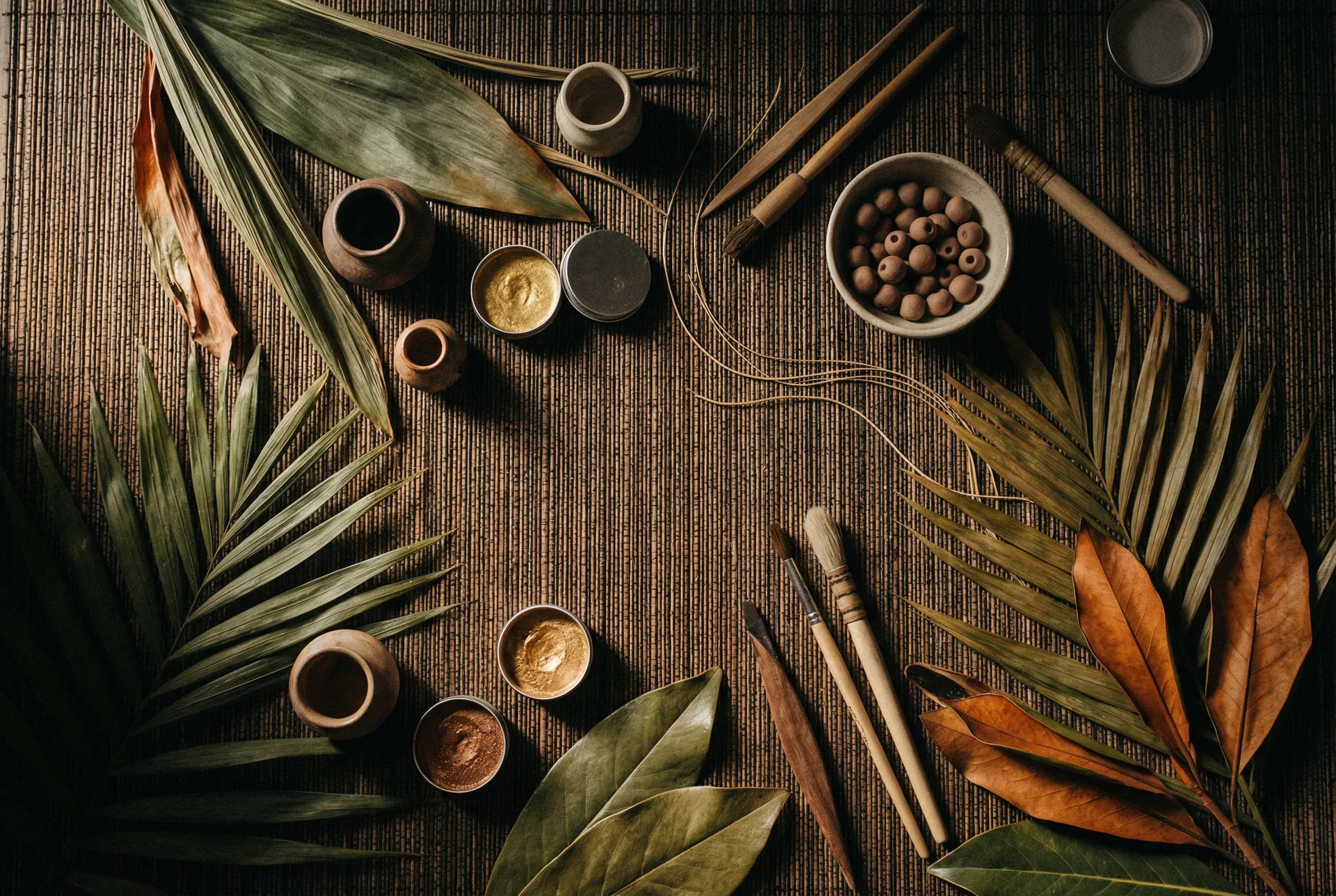
Each piece begins with the careful selection and preparation of natural materials. The process is meditative, deliberate, and deeply connected to the earth.
Preparing Materials
Selecting and preparing the Thaumatococcus Daniellii leaves
Leaf Selection
Choosing leaves at specific stages of natural decay
Stitching Process
Hand-stitching with Raffia reed to bind the composition
Composition
Arranging elements into the final spatial design
Layering
Building depth through overlapping organic forms
Final Details
Applying metallic accents and finishing touches
Looking Ahead
Future Essays
"Ọ̀rọ̀ Ẹni (Conversations with Self)" is the first of several planned artistic essays, each exploring new dimensions of the human experience through sustainable materials and Yoruba philosophy. The second essay, "Bí eré bí eré," is currently in development. The third essay, "Ọjà (Market Place)," has been announced. Two additional collections will follow, continuing the exploration of "The Similarities in Our Perceived Differences."
Follow the Journey
Stay connected with Olukokun Poroye's ongoing artistic exploration.